.png)
Breeding in Alpacas: Part 1 (Selecting your breeding herd)

Updated: Feb 13
First up in our alpaca breeding mini-series is selecting your breeding herd. For the complete series, check out part 1 (selecting your breeding herd) or part 2 (the mating process) or part 3 (gestation and pregnancy testing) or part 4 (birthing) and part 5 (early cria care) or part 6 (cria care beyond the first week).
Introduction
Before you begin breeding, it is essential to carefully select the alpacas that will make up your breeding herd. In this blog we will look at the key considerations involved in choosing suitable animals. This will provide you with a solid foundation, but if you would like a more in-depth understanding of alpaca selection and breeding, the British Alpaca Society (BAS) offers a range of advanced courses that you may find helpful.
Alpaca Terminology
Before diving head first into breeding alpacas, take plenty of time to research and familiarise yourself with some alpaca breeding terminology:
Maiden = female before her first cria
Hembra/Dam = female after her first cria
Macho/Sire/Stud = entire breeding male
Gelding = castrated male
Unpacking = giving birth
Cria = baby alpaca
Spit off = alpaca pregnancy test
Logistics of a Breeding Herd
Keep Male and Female Alpacas Separate
Same sex groups of 3 or more is recommended for alpacas. Male and female alpacas should NOT be housed together. This is for very real safety reasons... Males will fight to compete for potential mates using their fighting teeth, which are used in attempts to castrate rivals! Even after trimming, they can still inflict serious injury including partial or total castration. The act of mating is an incredibly invasive process (the penis penetrates through the cervix and into each uterine horn and lasts for an average of 20 minutes), so if allowed to happen regularly by males having full time access to females, it can lead to damage of the vulva and cervix, leading to infection and can cause undue stress and abortion. And castration does not always remove the urge to mate, so this can still be an issue with geldings too! If you wish to breed alpacas, pen mating is typically the recommended method.
Social Needs
Alpacas are incredibly social animals and become distressed and ill when kept alone, so alpacas should ALWAYS be kept in groups of 3 or more - but males and females should also be separate. So, if you want to keep a stud, he cannot be housed with females, nor can he be housed alone, so he will need at least 2 alpaca companions (either other working studs or fully grown males). This can be tricky logistically, so plan ahead how you will provide ample grazing for both groups, away from each other. Young males should be separated from females by 10 months old to avoid accidental pregnancies. Young males should not be put with fully grown entire males as the males can bully and injure them, so they should be weaned in same sex and similar age groups.
Selecting Your Alpacas
Characteristics
When selecting alpacas, it is important to choose animals that have good general health for longevity and meet your desired traits to optimise breeding potential in your herd and goals.
Key areas to consider:
Conformation (the shape and structure of the alpaca)
Fleece qualities and traits
Lineage
Temperament
Genetic compatibility between pairs (and avoiding inbreeding)
Conformation
Conformation (the shape and structure of the alpaca) should be at the top of your list to look at when choosing an alpaca, as this will indicative of the alpaca's general health, longevity and breeding potential. Below is a brief summary of a 'good' alpaca in terms of conformation:
Head shape - wedge shaped
Teeth - lower teeth meet upper pad
Neck - no dip, smoothly curves into back
Back - flat and straight
Legs - straight from front view and appropriately spaced
Feet - sound
Skin - healthy & supple
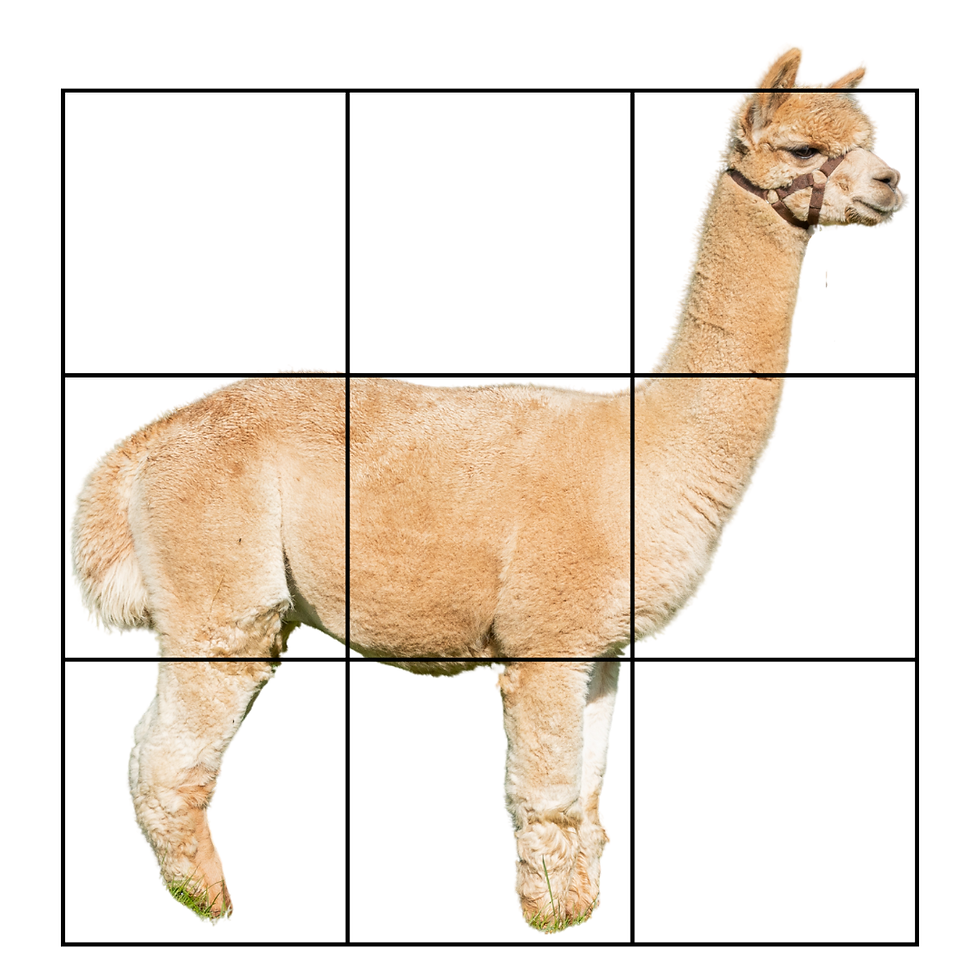
The alpaca should be in good proportions, which you can check by imagining a square grid over the alpaca, as below. The alpaca should neatly fit inside of the grid.
Fleece
The alpaca’s fleece keeps the weather out, keeping it warm and dry so it is important for an alpaca to have a good fleece. If you wish to produce product from the fleece, you will need certain characteristics and if you wish to show your alpacas, there are certain benchmarks to aim for. This blog does not focus on fleece (as there’s so much other information to get through!) so If you would like to improve your understanding of fleece, the British Alpaca Society offer several courses, which can be viewed here.
Below is a brief summary of what to look for in the fleece:
Colour - The natural colour of the alpaca’s fleece. Consistent, even colour is preferred for both showing and fibre production.
Fineness - How thin or fine each fibre is. Finer fibres feel softer and are more comfortable when worn next to the skin.
Density - How many fibres are growing per unit of skin. Higher density generally means a heavier, more productive fleece and better insulation.
Crimp - The natural wavy pattern of the fibre. Crimp contributes to the fleece’s loft, elasticity, and overall density.
Staple length - How long the fibres grow between shearings. Longer, evenly grown staples are easier to process and are preferred for commercial fibre use.
Uniformity - How consistent the fleece is across the entire body in all the key traits above. More uniform fleeces perform better both in processing and in the show ring.
Proven or Unproven
You may choose to purchase proven alpacas to reduce the likelihood of early breeding issues or unexpected fertility problems. Proven animals typically cost more than unproven stock, but the increased reliability often makes them a worthwhile investment. If you want to fast-track your breeding programme (reducing the wait for your first cria and avoiding the need to purchase and house studs immediately) you may opt to start with a trio of females in cria (already pregnant).
Selecting Females
Good conformation is important in both males and females, but in breeding females, particular attention should be paid to the hind legs. Narrow or cow-hocked rear legs may indicate a narrower pelvis and birthing canal, which increases the risk of dystocia (difficult labour).
Female Age Requirement
The minimum requirements for a female to be put to stud are that she must be at least 12 months old and have reached at least 65% of her dam’s mature weight. However, it is usually recommended that females be 18 months to 2 years old before breeding. By this age, they are closer to full physical maturity, reducing the risk of complications and supporting healthier pregnancies.
Selecting Studs
Whether you intend to keep your own stud males or rely on external stud services, choosing the right studs is crucial. Selecting a stud male is arguably even more important than selecting females. A fertile, willing male can potentially serve up to 18 females per week (based on three matings per day for six days, with a rest on the seventh). Over a breeding season, this equates to a significant number of cria - far more than a single female could ever produce, given that most dams will yield fewer than 15 cria over their entire lifetime.
Stud Age Requirement
Studs generally do not become effective breeders until around two years of age, when the penis has fully detached from the prepuce (foreskin). In some cases, this may occur earlier (particularly in more precocious, energetic males) so young males should always be separated from females by 10 months of age to prevent accidental pregnancies.
Will you invest in your own Studs or Stud Services?
If you plan to breed your alpacas, you will need to decide how to impregnate the females, either by keeping your own stud males or using external stud services. Each option has advantages and drawbacks.
How do alpaca stud services work?
Alpaca breeders often provide stud services in two ways: mobile mating, where the stud is brought to your location, or drive-by mating, where you transport your females to the stud. After the initial mating, a follow up visit can be arranged to perform a spit-off test (a common behavioural testing method used to identify pregnancy) along with re-mating if necessary.
The cost of stud services varies based on several factors, including the stud's proven breeding success, color, genetic lineage, and the level of service and guarantees offered. Careful selection of a stud is essential to achieving desired breeding outcomes.
How does keeping your own studs work?
Stud males should never be housed with or near females, as their presence can trigger aggressive competition, leading to serious injuries. Instead, studs should be kept in a separate area with at least two other fully grown male companions. Adult males should also never be mixed with younger males, as dominance behaviours can escalate into severe bullying, potentially resulting in fatal injuries. Maintaining a separate group of males requires additional space, time, and financial investment. If this setup is not feasible, an alternative option is to use specialised stud services, allowing you to breed females and develop a breeding herd without the challenges of housing stud males.
Which is right for your herd?
Owning studs provides convenience and control over breeding but requires additional resources such as separate grazing and facilities to the females, and provisions for their ongoing care. On the other hand, using stud services can be cost-effective and eliminates the need for maintaining males, but it may involve transportation logistics and availability constraints. Factors such as budget, land capacity, and herd management should be carefully evaluated when making this decision.
What is the Fatal Grey Gene in Alpacas?
The fatal grey gene in alpacas refers to the 25% chance of grey to grey matings producing a fatal gene which results in either the pregnancy not establishing or getting reabsorbed; usually occurring in first 3 months of pregnancy. According to Futuregen, grey dams are likely to produce grey offspring 50% of the time, no matter what colour of stud they are paired to. Grey to grey matings (genetically grey alpacas - not just those who physically present as grey) have a 50% chance of producing grey cria, a 25% chance of producing non-grey cria and a 25% chance of producing the fatal gene.
Expand your knowledge
There's a lot to learn about breeding alpacas, such as selecting your alpacas, the mating process, supporting the female through gestation, testing for continued pregnancy, the birthing and what to expect as well as trouble shooting problems including malpresentation - when you can correct it and when to call the vet - as well as early cria care and care beyond the first week. The Alpaca Breeding Course, here at Fostings Alpacas offers all of this in a mixed theory and practical delivery, so you come away confident in knowing what to expect when breeding alpacas.
Disclaimer: Fostings Alpacas are not a veterinarian body. Always consult your vet when creating a health plan for your herd and if you are ever concerned about your alpacas.


